

Hope Lies High in the Valley
HAUT ESPOIR
Friday 5 July 2019
https://www.hautespoir.com/
Dr Peter Rating – Experience: 3.5/5
Dr Peter Rating – Wines: 3.5/5
Hearty Food and Wine Brought by the Stork at Hartenberg
HARTENBERG WINE ESTATE
Saturday 29 June 2019
http://www.hartenbergestate.com/
Dr Peter Rating – Experience: 4.5/5
Dr Peter Rating – Wines: 4.5/5
I have greatly enjoyed Hartenberg wines at successive Stellenbosch Wine Festivals, the Shiraz & Charcuterie Festival and at a Steele Wines Trade Show but I have never visited the estate itself for tasting. It has been a wait of 2 years so I was pleased again to be in the Bottleray Road area, North-West of Stellenbosch. My plan was to visit Hazendal and Fort Simon before going to Hartenberg for lunch and wine tasting. At last!


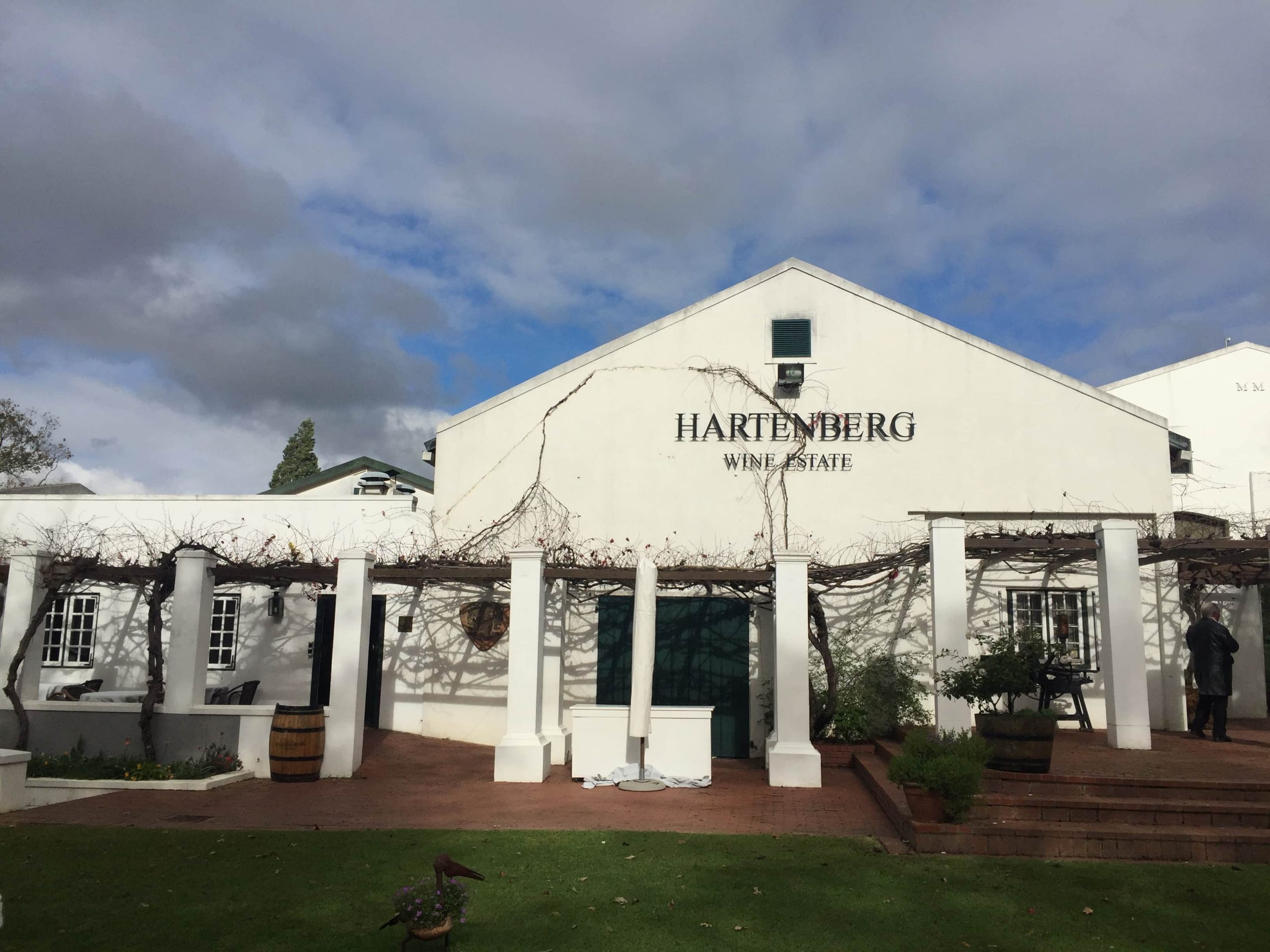
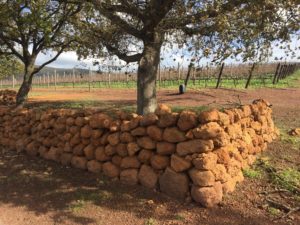
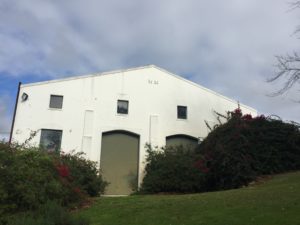
I nearly missed the entrance in my excitement before heading up the paved road through winter vines with detailed signs for each block. A low stone wall gave clue to the free draining soils on the North, West and East facing slopes of the Bottleray Hills that bring either morning or afternoon sun to the varietals. I parked above the Tasting, Restaurant and Cellar historic buildings with their quintessential white washed walls and heritage green painted windows.

The walk to the Tasting Room is past a slave bell and down a flight of steps. Slave bells remain on many of the Cape’s wine estates and, as I paused to look, I was unsure of the ‘monument’. Slave bells were brought from Europe to regulate and control the routine of slaves for 180 years until slavery was abolished in the Cape 180 years ago. There is a fine balance between retaining the history of a nation and modern day diversity, inclusiveness and sensitivity. Witness, for example, the name changes of countries, regions and streets; removal of the Cecil Rhodes Memorial in Cape Town following pressure from the #rhodesmustfall campaign born out of the 2015 #feesmustfall movement; or even last week’s decision by Nike to withdraw the special 4th July edition of the Max 1 trainer that featured the Betsy Ross flag. The two needs do not always sit together in balance -especially when symbols can be hijacked by others for other needs long after their original purpose – and so I make a mental note to return to the Iziko Slave Lodge Museum in Cape Town.


I was reminded of the history of winemaking at Hartenberg by a 1920 piston wine pump as I make my way for tasting. The estate dates back to 1692 when settler friends Cunraad Boin and Christoffel Esterhuizzen were given permission to farm 20 hectares of land. They cleared it to plant 2,000 vines (I wonder what cultivar?). Christoffel was granted the title deed for ‘Het Hartenberg’ twelve years later, in 1704, by Governor Willem Adriaan van der Stel. The property was planted with 10,000 vines by 1718 to produce 4 leggers of wine. A legger is an Old Dutch unit of liquid capacity used by the East India Company, equivalent to around 575 litres in today’s measure. Ownership of Hartenberg changed hands many times during the next 260 years, including by the Finlayson and the Gilbey families, until Ken Mackenzie purchased the estate in 1987, 2 years after launch of the Hartenberg flagship brand. Today, 85 hectares of the 187 hectare property are under vine, growing Sauvignon Blanc, Chardonnay, Riesling, Cabernet Sauvignon, Merlot and Shiraz from which the wines are made. Production is mostly red (80%) with Hartenberg famed for its Shiraz.
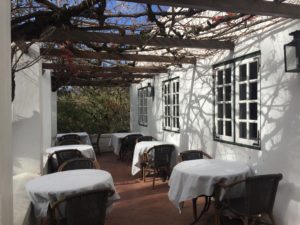
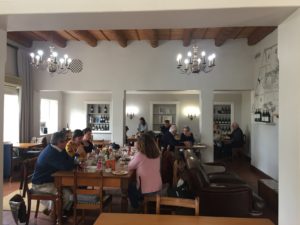

I chose to sit inside the Restaurant-come-Tasting Room rather than outside in the Courtyard Garden or small Tasting area beneath. The Tasting Room shares the same space as the Restaurant (closed on Mondays and Tuesdays) to make for a warm and cosy environment to relax in and to enjoy the wines, with its log fire, yellowwood tables, riempie chairs and terracotta tile floor. There were several winter specials on the menu to tempt. I ordered a very tasty and filling beef ‘Hartenburger’ that was excellent value for R120 and came with crisp potato wedges. There were 2 wine tasting options: the Premium Wine Tasting, R50 for 5 wines from the Premium Range; or the Super Premium Wine Tasting, R150 for a set tasting of 5 of older vintages of the best wines, including the Flagship Gravel Hill Shiraz. I opted for the former. Roderick was my attentive and very knowledgeable host who, seeing my obvious interest in the wines, generously allowed me to taste from both ranges.


I enjoyed the white wines in 2 paired flights to compare. First, were the dry and off-dry Riesling. Both wines were a similar shiny pale straw colour in appearance and contained 13% alcohol. The dry wine showed typical Riesling diesel notes balanced with lemon/lime citrus, delicate white honey and floral aromas. These followed through for a fresh, green, acidic palate with a medium finish. The off-dry wine, picked later and with longer skin contact for a more concentrated, acidic must, offered like lemon/lime notes but sweeter and with less pronounced diesel on the nose. The body was noticeably fuller on the palate with a greater intensity of flavour than the dry wine, with the extra sugar (20 gram/litre compared to 5 gram/litre residual sugar) deftly balanced by the higher acidity to maintain freshness.


Second, was Chardonnay from the two different ranges. They were of like pale-medium straw colour and both barrel fermented and matured. The Estate wine, blended from 4 blocks of vines, was shy on the nose with aromas of lemon, lime, yellow apple and buttery vanilla. The smooth mouthfeel and light style made for a Chardonnay with a delicate elegance albeit limited complexity. Unsurprisingly the Super Premium Eleanor at nearly 3 times the price, made from a single block and named after matriarch Eleanor Finlayson, showed a greater intensity and complexity on both nose and palate. The wine was richer and weightier with much better length, aided by longer ageing in a smaller proportion of new French oak (13 months in 25% new/75% old oak compared with 11 months in 34% new/66% old oak). I preferred the Eleanor.


It was soon time to enjoy the red wines on which Hartenberg’s reputation is built. I started with two well made Estate wines of 2016 vintage, a Merlot and a Cabernet Sauvignon. The wines were distinct and characteristic of the cultivar. I liked the Merlot most for its vibrant red cherry and red plum fruited nose, complemented by sweet spice and cigar, that well followed through to give a good intensity of flavour and classic silky Merlot tannins.


The Cabernet Sauvignon substituted spicy sweetness for more herbal, minty flavours, red fruits for fresh dark fruits – blackcurrant, blackberry and mulberry – and tannic silkiness for cleaner, textured yet angular and youthful structure in which the fruits did not balance the tannins as well as for the Merlot.
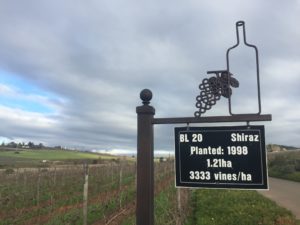

I sampled the Estate Shiraz beside the Stork Shiraz which, like the Chardonnay had a three-fold price difference. The Estate wine, from grapes grown on rocky sandstone soils, was a classic, lighter styled Shiraz with medium purple colour, fresh cherry, plum and mulberry fruits, a tinge of greenness and white peppercorn on the nose together with a delicate and balanced palate.

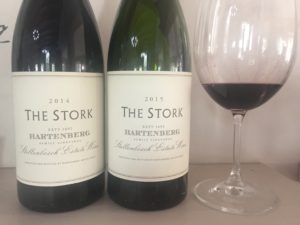
The Stork, which I had previously tasted elsewhere, was a step up in all wine criteria. Named after WWII fighter pilot Ken ‘Stork’ Mackenzie, so-called because of his long thin spindly legs, the wine was deeper and more intense in appearance. As fruity as the Estate, the wine was more vibrant, less green in character and with a leathery smokiness to the darker fruits of black cherry, dark plum and cassis with their cinnamon and pepper spice aromas. Slower ripening grapes from the single vineyard on cooling clay soils meant that the latest of harvests brought a rich, ripe fruitiness of flavour that superbly balanced tannic grip and structure on the palate.

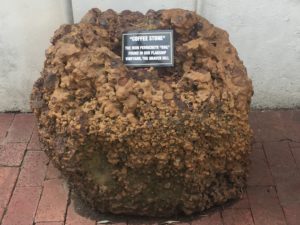
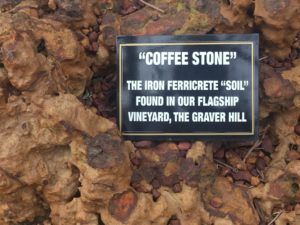
The Stork was my favourite wine until Roderick persuaded me to end with a tasting of the flagship Gravel Hill Shiraz, double the price of The Stork at a dizzying R1300 per bottle. I needed little persuading as he poured me a glass using a Coravin to maintain wine quality once opened. I had a new favourite wine. The wine, made from grapes from the small and unusual ‘gravel hill’, was first made in 1978. It develops very slowly and is labelled only after 5 years, this being of 2006 vintage. The unique geology rests on concentrated iron laterite ‘koffie-klip’ stone underlain by fine, deep clay. The combination gives water retention in the wet winter whilst just enough of a reservoir for summer moisture to limit vine vigour.
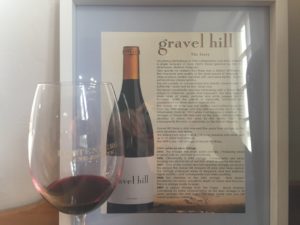
The Gravel Hill was the fullest bodied wine of the tasting with a rich and deeply intense nose of brooding blackcurrant, mulberry, bramble, ripe plum and white peppercorn. The wine, like all classics of supreme quality, had a freshness that belied its age. Power, focus and concentration were the hallmarks of the palate that was smooth, intense and perfectly balanced. Intriguingly, and testament to its quality, I could drink this wine alone as much as with food.


Hartenberg was well worth the wait, as I had much expected. The wines were all extremely well made, with good cultivar definition, and priced at the right level for their quality. I liked the wide price range (from R95 for the entry Alchemy Range, which I did not taste, to a stratospheric R1300 for the Gravel Hill) that meets those of every budget. The experience was good too with pleasant setting where it was easy to enjoy simple home-made food whilst sampling the wine. I could easily have chosen any item off the lunch menu. Sadly, I did not think of visiting the underground cellar, the largest privately owned of its kind in South Africa, but that just gives me an excuse to return. This I shall. I recommend that you also do so. Oh, and bring a friend or two for lunch at the same time.
#capewinelover #DrPeter
Wines tasted (bought *):
White:
2017 Riesling (dry) -R120*
2017 Occasional Riesling (off dry) – R120*
2016 Estate Chardonnay – R140
2016 The Eleanor Chardonnay – R375
Red:
2016 Estate Merlot – R200
2016 Estate Cabernet Sauvignon – R200
2016 Estate Shiraz – R200
2016 The Stork Shiraz – R700
2006 Gravel Hill Shiraz – R1300 FAVOURITE WINE
Com-fort-able Wines at Fort Simon
FORT SIMON WINE ESTATE
Saturday 29 June 2019
http://www.fortsimon.com/
Dr Peter Rating – Experience: 3.5/5
Dr Peter Rating – Wines: 3.5/5

Individual Quality at Jordan
JORDAN WINE ESTATE
Thursday 27 June 2019
http://www.jordanwines.com/
Experience: 4/5
Wines: 4/5


Being Creative at Flagstone
FLAGSTONE WINES
Wednesday 19 June 2019
http://www.flagstonewines.com/
Experience: 4/5
Wines: 4/5

Diploma Done and Dusted – But for the Final Result – I Passed!
CAPE WINE ACADEMY – DIPLOMA COURSE – FINAL TASTING & EXAMS
Monday 10 June 2019
http://www.capewineacademy.co.za/index.php
Experience: 4/5

Superb Views of Guardian Peak
GUARDIAN PEAK WINES
Friday 26 April 2019
https://www.guardianpeak.com/
Experience: 3.5/5
Wines: 3.5/5
Waterf-ord More Ord-inary Than Extra-ord-inary
WATERFORD ESTATE
Thursday 25 April 2019
https://waterfordestate.co.za/
Experience: 3.5/5
Wines: 4/5
Waterford is another of those big name wine estates amid the other 800 or more in the Western Cape (and a growing number beyond too) that I have wanted to visit for some time. I have tasted at over 200 wineries since I started the Cape Wine Lovers’ Society over 2 years ago so there are several more to visit and review. Like many, I had sampled the Waterford wines before at festivals and other events but there is no substitute in my mind for tasting a wine at the place at which it is made, ideally looking out over the vineyards whilst doing so. The occasion was a mid-week break in the Upper Blaauwklippen Valley, South of Stellenbosch during which I planned to taste also at Kleinood Winery (Tamboerskloof wines), Keermont Vineyards and De Trafford Wines.


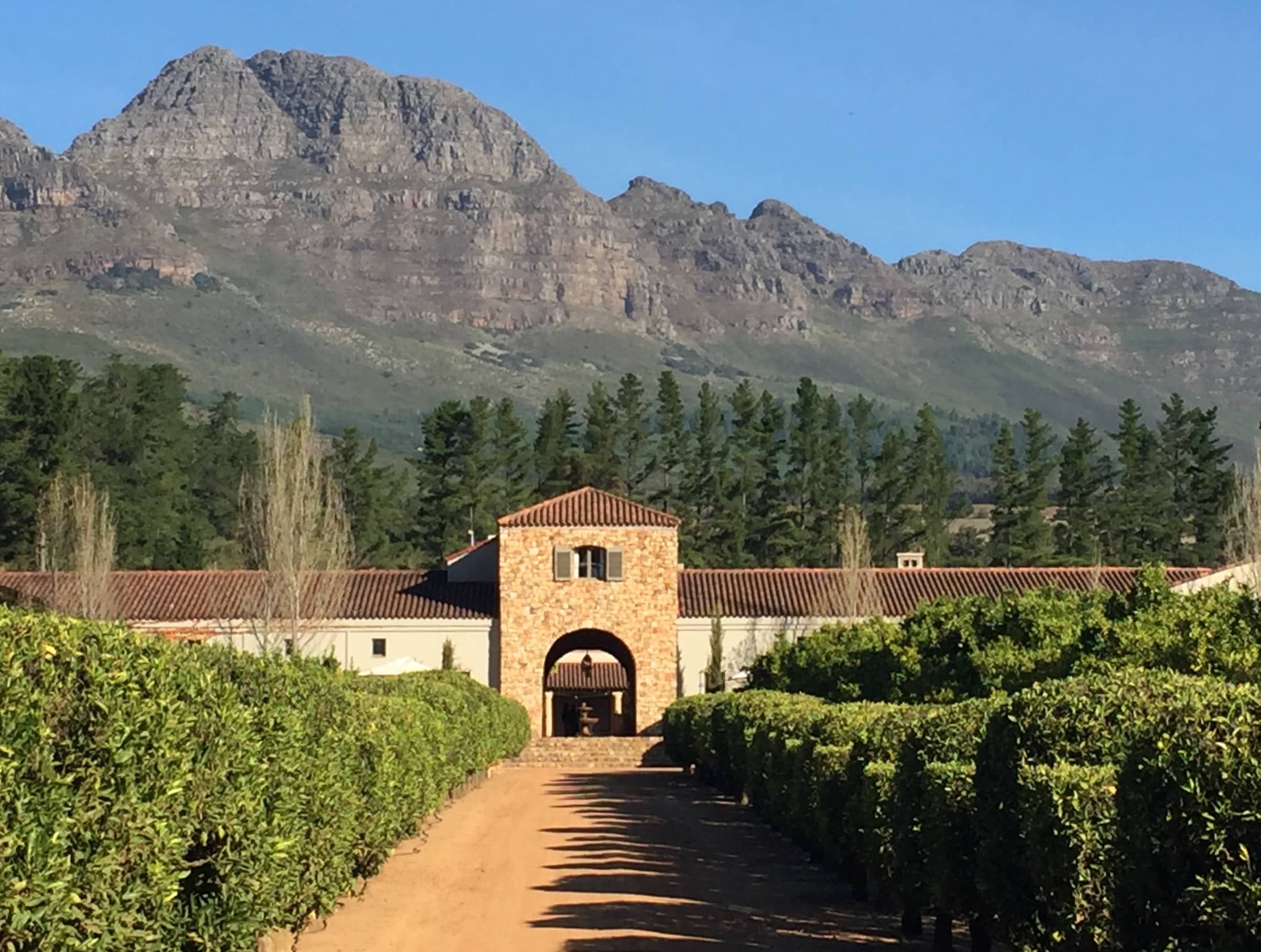
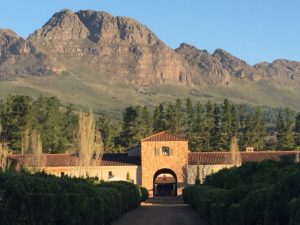
The stone walled entrance (opposite Kleinood) showed presence and status, leading to an impressive tree lined avenue that gave dappled shade from the bright late-afternoon autumn to winter sunshine. Growing ever closer and through the Clementine orchards, framed above by the stony Helderberg Mountains, were the cellar buildings with their red corrugated tile roofs and stately, central arched tower. I parked close by and tried to decide the architecture in my own mind. It was part Italian, part Spanish perhaps – much as I might expect a Californian winery – but certainly not Cape Dutch. The website refers to the ‘Mediterranean courtyard’ so I guess I was half right twice.


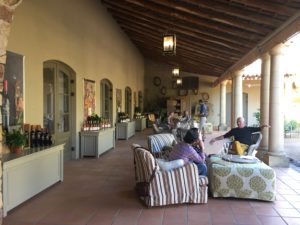
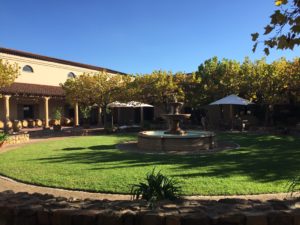
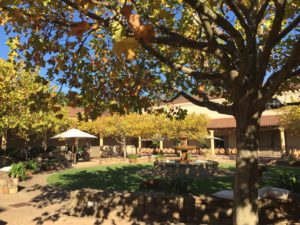
Impressive the arrival at Waterford certainly was. It was all the more so as I ventured into the large circular courtyard inside, complete with central gushing trademark Waterford fountain. Expansive, upholstered, and no doubt expensive sitting rooms flanked either side of the entrance with their large open fireplaces, terracotta floor tiles, designer décor and extravagant flower decorations. Further couches and low tables filled the verandah outside in case inclement weather prevented tasting whilst sat on the low circular wall around the fountain.
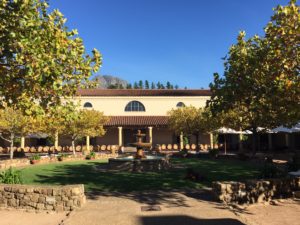
Waterford clearly meant to make a statement and a statement it did. I chose to sit at one of the many small tables at the edge of the courtyard so I could taste and write with ease. The Waterford Tasting Experience lists 7 options. I would have expected no fewer from the grand setting. Two of these require pre-booking (the 3 hour Estate Wine Drive and Porcupine Trail Walk, at R1,150 and R450, respectively) and are part of the ‘Waterford Way’ which is ‘to be prosperous’. There were 2 wine and chocolate pairings – or rather, ‘Experiences’ – for 3 or 6 wines, costing R95 and R125. There was also a single tasting of the Jem (R115) which is Waterford’s flagship wine – named after owner Jeremy Ord, also as in Waterf-ord – which is a blend from a selection of the 11 estate cultivars grown on the estate and first released in 2007; 8 for the 2014 vintage at an ethereal cost of R1,650 a bottle. Being neither ‘prosperous’ nor fortunate enough to have held the contract for Waterford’s marketing material, I opted to skip the Library Collection Tasting (R250 for a selection of unique and limited blends) for the basic or rather ‘Portfolio Tasting’.


While I waited for Thomas to bring the first of the 6 wines, I was reminded of Vrede en Lust whose lifestyle, entry level wines are part of their Premium Range. The wines came in set ord-er (pun intended) beginning with the Rose-Mary that is named after Jeremy’s late mother. This was a Rosé – more correctly from the website ‘a very sophisticated approach towards a blanc de noir’ – that was pale salmon pink in colour. Made from Shiraz, Mourvèdre, Tempranillo and Grenache grapes, picked early to be bone dry (1.1 grams per litre residual sugar) and low alcohol (10.8%), the wine showed typical sweet strawberry and raspberry aromas with a hint of white spice and medium intensity. The palate did not show much sophistication for me, with a weak follow though, little weight and low complexity (a different ord-er of magnitude to the outstanding Tamboerskloof wine I had earlier tasted at Kleinood opposite).
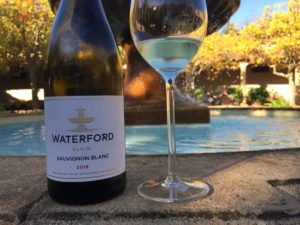
Next was the first of 2 white wines. In contrast to the Rosé, the Elgin sourced Sauvignon Blanc was almost too big on the nose with intense forward aromas of guava, litchi and pineapple that gave way to grassy, citrus, green pepper notes that belied the pale straw colour. I did not expect this degree of tropical fruit salad flavour for a cool climate wine but perhaps the 2018 drought and summer heat contributed or even yeast selection. The palate was dry, clean and fresh as expected of the variety but with very little flavour. The contrast with the aromas was as marked as the shadows around me as light and dark danced at the end of the afternoon.

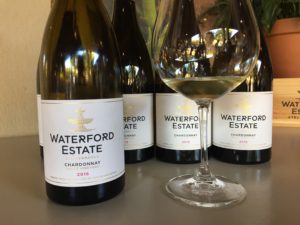
I rated the Chardonnay, served in correct ‘balloon’ glass, the same. The grapes come from a single block (5.8 hectares) of vines that were planted in 1988, making them some of the oldest Chardonnay in the Cape. Barrel-fermented for 9 months in 24% new oak, the wine showed a pale gold colour. This was classic medium-oaked South African Chardonnay: sweet citrus, vanilla and pecan nut aromas of decent intensity, a smooth mouthfeel, and medium complexity. I would have rated it higher except that the acidity was not fully integrated to leave a bitter aftertaste.

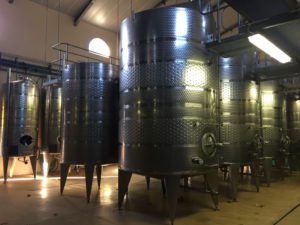
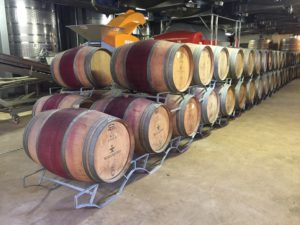
The Waterford Estate has been owned by a partnership between two families since 1998, before which it was part of the adjoining Stellenrust farm. Jeremy and Leigh Ord purchased the property whilst Kevin and Heather Arnold have developed the wines to make it the estate it is today. Half of the 120 hectares are under vine with a wide selection of French, Italian and Spanish cultivars being grown, with the remaining 60 hectares set aside for conservation. Red wines form the majority (70%). The winery was designed by Alex Walker using stone from the vineyards and local quarries as well as timber from the estate.
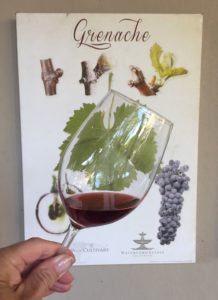
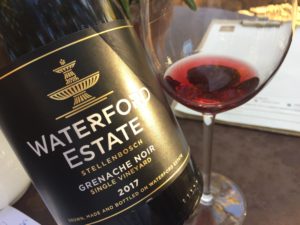
My favourite wine of the tasting was the Estate Grenache Noir that could by its pale ruby appearance easily have been mistaken for a Pinot Noir. Look out for more Grenache in South Africa, better known for Priorat (as Garnacha in Spain) or as the major component of Château Neuf-du-Pape and many Rhône blends, due to its drought-resistance. The grape makes for a muscular and spicier Pinot Noir with more body, tannin and alcohol and lower acidity. Thomas described the wine as ‘a red wine like a white wine; a white wine like a red wine’ and I could see how it could appeal to traditional white wine drinkers who do not enjoy red wine. The nose showed a bright intensity of smokey, gamey cherry and currant fruity aromas with a hint of maraschino. The wine was bolder on the palate than I expected and certainly more so than a Pinot Noir.

The Kevin Arnold Shiraz was next which I had tasted at the Charcuterie & Shiraz Festival in Franschhoek last year. Subtitled Katherine Leigh, youngest daughter of the Ord family, the wine showed a better intensity of aroma than flavour. The nose showed good complexity of fruit, floral and savoury notes – sweet plum and dark fruits, violets, leather and meats – that lessened on the palate for a lighter styled wine. Tannins nonetheless were structured and green olive in flavour.

Cabernet Sauvignon was the final wine of the tasting as the shadows lengthened in the courtyard. It is Waterford’s leading varietal (30% of plantings) and made with 6% added Cabernet Franc, Petit Verdot and Merlot for colour, perfume and structure. The medium-bodied wine was made in lighter style than many Stellenbosch Cabernets. It showed good fresh red and dark fruit aromas of cassis, blackberry, black cherry, pencil shavings and green herbs. The tannins were closed and forwards on the palate, with classic drying mouthfeel, for a bright finish as befitting its youthful age.

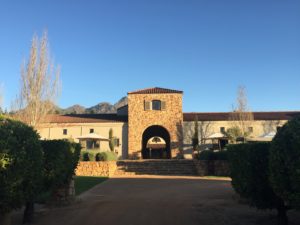
Waterford promised so much. The impressive approach, mountain backdrop and setting, the grand design, opulent Tasting Room and the wide circular courtyard spoke of the Waterford ‘prosperity’. The wow factor is definitely there and a lure for the many American and other foreign tourists beside me. It is undoubtedly the kind of wine estate that is made for the coffee table winery books and vice versa. That is all well and dandy for me and part of the rich and diverse South African wine landscape and heritage. The proof for me as a wine journalist, student and connoisseur lies in the wines. Waterford ticked all the right boxes. There was a broad selection of the best known white and red wines to show off the best of the Stellenbosch terroir. There was a Rosé too and a wine from Elgin (the Sauvignon Blanc). There was the interest cultivar too with the Grenache rather than a Pinot Noir. Wine quality was however variable, with the red wines higher rated than the white wines. The service level was variable too, even for late afternoon when there were relatively few customers, and I had to wait too long between some wine servings. Wine prices were well above average which did not surprise. The Waterford name itself brings premium pricing (as did the tasting fee) that many a tourist will not even notice.
I enjoyed Waterford and was pleased to have visited and tasted the wines, which was my motivation to go. The wow was more from the buildings than the wines. I was reminded on leaving of my experience at the similarly named Waterkloof (I often get the 2 estates muddled up for that reason) that also underwhelmed as expectation fell below experience. Overall, Waterford was more ord-inary than extra-ord-inary.
Wines tasted (bought *):
White:
2018 Waterford Elgin Sauvignon Blanc – R132
2016 Waterford Estate Chardonnay – R272
Rosé:
2018 Waterford Rose-Mary Blanc de Noir – R116
Red:
2016 Waterford Estate Grenache Noir – R295 FAVOURITE WINE
2014 Kevin Arnold Shiraz – R295
2016 Waterford Estate Cabernet Sauvignon – R356


Dave Goes Down Under and the Wines Go Up
CAPE WINE ACADEMY – DIPLOMA COURSE – MODULE 4 – DAY 2
Saturday 27 April 2019
http://www.capewineacademy.co.za/index.php
Experience: 4/5