
Mooi Mooi Mooi Mooiplaas
Mooiplaas was so close to Kaapzicht – barely a kilometre up the tidy gravel road – that I could not resist visiting. I was super pleased that I did. Today was my second day in less than a week visiting the Bottleray Road vineyards – Bellevue, Goede Hoop, Groenland and Kaapzicht – and Mooiplaas beckoned me for being so close and because I wanted to taste their wines.


The road beyond Kaapzicht passed through ripening vineyards and to a shady grove where I parked. Horses were enjoying the dappled shade from the intense summer sun in a field beside the parking area. Tables and chairs were set outside beneath the large (fittingly for a wine farm) oak trees beside a long Cellar building as I made my way into the Tasting Room and introduced myself to Nico, who looked after me superbly well throughout.


I sat outside and chose the premium Mercia tasting selection (R60 for 5 wines), named after the wife of the original owner Nicolaas Roos, that included many of the best red wines that Mooiplaas makes. 
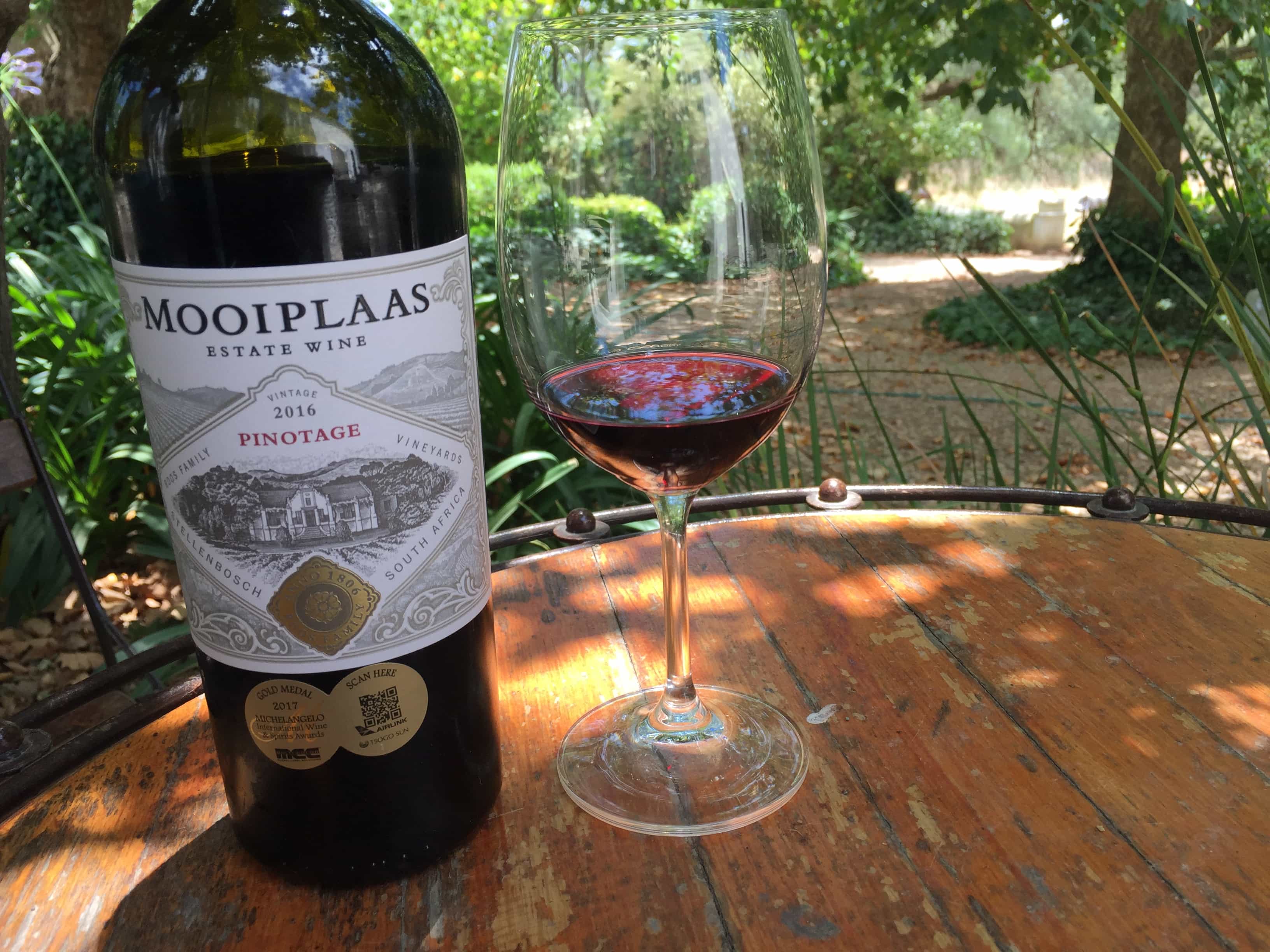
The start was interesting and unexpected. Pinotage, I’ll admit here, is not my favourite cultivar. The wines are very varied in both style and quality – read more about my experience at last year’s Pinotage and Biltong Festival – and I like fewer than I dislike. The wine was full bodied but a pale ruby colour and almost opaque in appearance. The bouquet was shy, more cherry than plum, and fruity not juicy. White spices emerged on the palate to match delicate tannins that made the wine not unlike a Pinot Noir in character. Nico told me that the wine was unwooded – rare for a Pinotage – and I liked it.


The Watershed Syrah from the flagship Mercia Collection was refined and distinct. Dusty spices attracted me to the nose that showed typical notes of cassis, blackberry and sun-filled blackcurrant. The tannins were luxurious and opening, smooth and well balanced with the alcohol and fruit flavours.


I rated the Rosalind, a Bordeaux-style blend, as highly. Again, it was not big on the nose but showed restrained earthy red cherry, cranberry, and dark plum aromas. The mouthfeel was firm and plush, superbly balanced, and with tannins from 12 months in French oak giving weight and length to the wine.


It made sense next to taste the 2 Cabernets Sauvignon – one each from the Roos Family Range and the other from the Mercia Collection – together to compare. The Tabakland is slightly deeper ruby in colour. The Roos wine is classic Cabernet Sauvignon with a good intensity of red and dark fruits. The tannins are tight and dry to give a lingering finish. I sense a dryer nose on the Tabakland with hints of dry leaves to the berry fruit aromas. Nico tells me that the farm used to grow tobacco as well as vines, until Government regulations made it commercially impossible, and that the block of Cabernet Sauvignon is where the tobacco was planted. I cannot specifically smell or taste tobacco – even when Nico mentions it (one so often ‘finds’ the flavour when one is told of it or reads it on a label!) – but there is an earthy leafy feel to the wine. I enjoy the deeper berry flavours and tight but softening tannins on the palate.


Tielman Roos, the Viticulturalist, passes by and stops to chat. It is a busy time of year for him. He tells me that the vines are holding up to the drought. Vines that are planted well and that are well managed will survive, better than citrus. Mooiplaas has 90 hectares of them on the 240 hectare property, together with a sizeable 70 hectares of Renosterveld fynbos that was established as a private nature reserve in 1995. Tielman’s father, Nicolaas Roos, bought the farm in 1963. The uneven terrain, dominated by Cape Granite, with its slopes and different altitudes give subtle differences in microclimate that make up the terroir.


I ask to taste a few more wines. The Vino Baruzzo Novello, in blue printed paper sleeve on the shelf in the shop area, intrigues. “Is this made with an Italian cultivar”, I ask Nico? He explains the story behind that is told also on the sleeve. The wine is a Merlot (the bottle is unlabelled inside). The name reflects the Italian prisoners of war, captured in 1940, who were brought to South Africa and worked on farms when the war ended. The Officer in charge of a group of 5 prisoners was a Lieutenant Baruzzo who grew up on a wine estate. He built the cement and concrete fermentation tanks that are still in use in the Cellar today. It did not surprise as I saw cement tanks only a few days ago at Goede Hoop, just a few kilometres away, and previously at Delheim where they too were built by Italian POWs.

The wine intrigued like the Pinotage, even more so when Nico told me that whole bunches are little pressed and fed CO2 in stainless steel fermentation tanks. The wine was of medium body and a pale ruby in colour. The nose contained red fruits of cranberry, redcurrant, cassis and red cherry. The red flavours remained in the palate on which maraschino flavours unexpectedly emerged. There was grippiness to the wine, with low alcohol (10.5%), and a dry finish. This was another rare, unwooded, red wine and I mused that it had an almost red grapetizer taste to it. I liked it enough to buy a bottle.


I could not resist sampling 2 white wines to end. Both were of 2017 vintage and from the Roos Family Range. The Sauvignon Blanc showed a good complexity of herbaceous green and tropical fruit flavours – green fig, watermelon, granadilla, guava, pineapple – with a bright and fresh acidity to balance. I rated it as high as any of the red wines.


I rated the Chenin Blanc – my favourite wine of the tasting (but only just!) – as highly. Made from 43-year old bush vines, the oldest on the farm, the wine oozed delicious aromas of peach, tangerine, honey and apricot on the nose. There was just the right amount of bright acidity to complement the dry to off-dry mouthfeel. I bought a bottle.


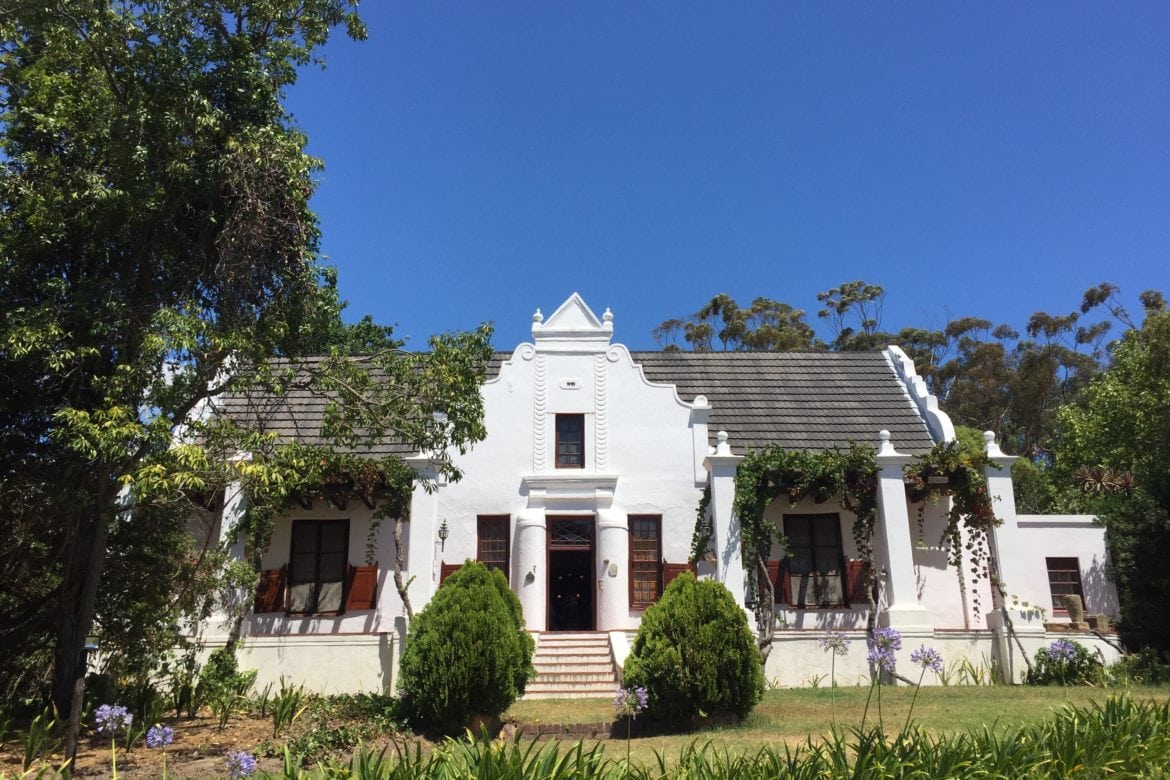
Mooiplaas was a great experience and in a relaxed setting for tasting. I wandered along the road to see the historic, white-painted Dutch-gabled, 1806 Manor House before buying my 2 bottles of wine – the first and last wines I tasted. Unlike at Kaapzicht, I was well looked after by Nico who was enthusiastic about the farm and its wines. The wines are ‘traditional’, ‘authentic’, ‘classic, ‘structured’, balanced’ and ‘artisan’, words that fill the pages of the Mooiplaas website. I confess I give little credence to what others write, or judge, or the price of, or history, or the reputation of wines I have not tasted or vineyards visited. I value my independence and like to taste for myself, ideally in the wine farm or the estate in which the wine is made. The Mooiplaas wines certainly fitted those descriptors and there was not a badly made wine in the range I sampled. I would certainly taste again – and buy ‘blind’ without tasting in future. There are few wine estates where I am confident of the style and quality of their wine for me to do this. Mooiplaas certainly was a ‘beautiful farm’. It and its wines were truly ‘mooi’ ….
Wines tasted (bought *):
White:
2017 Roos Sauvignon Blanc – R105
2017 Roos Chenin Blanc – R90 FAVOURITE WINE
Red:
2016 Pinotage – R110*
2012 Watershed Syrah – R280
2010 Rosalind (44% Cabernet Sauvignon, 44% Cabernet Franc, 9% Merlot, 3% Petit Verdot) – R280
2015 Estate Cabernet Sauvignon – R145
2015 Tabakland Cabernet Sauvignon – R280
2015 Vino Baruzzo Novello Merlot – R70*


Pingback: PicknPay Pairs it again at the Stellenbosch Wine Festival – Cape Wine Lovers' Society
Pingback: Hazendal Fit for a Tsar, a Hare and a God of Wine – Cape Wine Lovers' Society